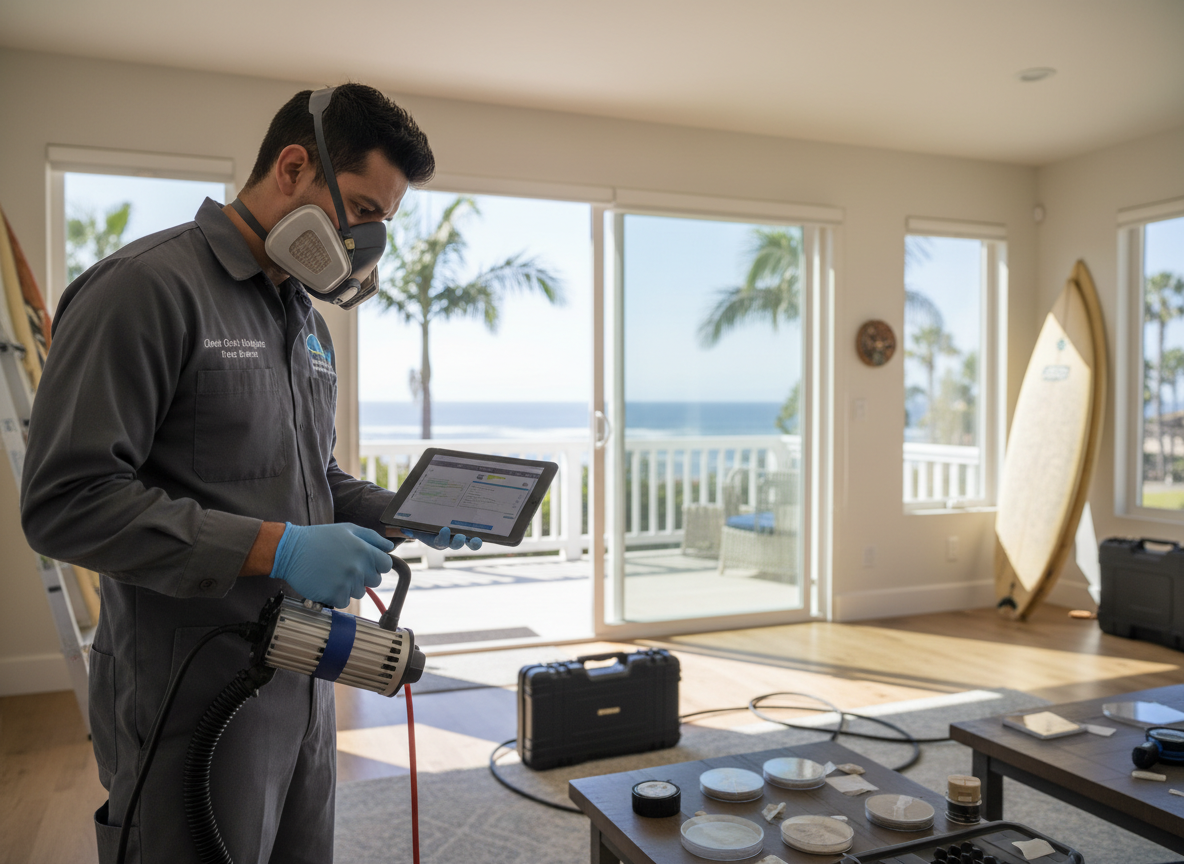
Solana Beach sits in a mild coastal Mediterranean climate where ocean air keeps relative humidity elevated year-round, especially in neighborhoods like Lomas Santa Fe and Solana Highlands. Older single-story homes and townhomes built before current ventilation standards often trap moisture behind stucco or under raised floors near the San Elijo Lagoon. Air quality and mold testing here starts with calibrated spore traps and tape lifts in living spaces, attics, and crawlspaces to map concentration differences between indoor and outdoor samples. Technicians also check HVAC returns because salt-laden air accelerates corrosion on coils, creating hidden reservoirs that standard visual inspections miss.
Testing protocols account for the county's occasional winter rain events that push water under door thresholds in Downtown Solana Beach properties. Surface samples from baseboards and window sills reveal whether recent fog intrusion has activated dormant spores. Air sampling runs for five to ten minutes per zone while occupants remain in place so results reflect actual breathing-zone exposure. Reports include genus-level identification and recommended next steps without assuming remediation scope until clearance testing confirms levels have returned to background.
Edge cases appear in homes backing the Solana Beach Coastal Rail Trail where train vibration can loosen seals around plumbing penetrations, allowing moisture migration into wall cavities. Testing crews document these pathways with moisture meters and borescopes before any disturbance. Results are compared against reference samples taken at Fletcher Cove Park to isolate truly elevated indoor conditions from normal coastal background.
Technician insight
In Solana Beach the thing that catches most people out with air quality and mold testing is how the constant ocean influence in Lomas Santa Fe homes keeps crawlspaces damp even when the rest of the house feels dry, so we always pull samples from under the floor joists near the San Elijo Lagoon side rather than stopping at visible rooms.
Hidden Growth Behind Coastal Stucco
A Solana Highlands homeowner noticed musty odors after winter fog but saw no visible stains. Sampling showed elevated Aspergillus indoors versus outdoor controls. We traced moisture to a compromised window seal allowing salt air into the wall cavity. Targeted removal and follow-up clearance testing brought levels back to background.
How it works
- 1
Initial Consultation
Discuss symptoms and property history over the phone or at 911 Lomas Santa Fe Dr to determine sampling locations.
- 2
On-Site Sampling
Collect air and surface samples from targeted zones including attics, crawlspaces, and HVAC systems while recording moisture readings.
- 3
Laboratory Analysis
Send samples to an accredited lab for spore identification and concentration counts relative to outdoor controls.
- 4
Report Delivery
Provide written findings with location-specific recommendations within 48 hours of lab results.
Pricing
Cost depends on number of samples, property size, and whether HVAC or crawlspace access is required.